Complete systems.
One real problem from first principle to finished thing. No disconnected hacks, recycled threads or template piles.
A growing library of practical, end-to-end playbooks for marketers, creators and operators. Figures inside are labelled by how well they are supported, from official sources to explicit estimates.

AdeptKit is built around the decisions practitioners actually make, then compressed into systems, benchmarks, failure modes and execution tools.
One real problem from first principle to finished thing. No disconnected hacks, recycled threads or template piles.
Playbooks, failure modes, audits, worked examples and definitions of done. The unit of value is execution.
Figures are labelled by how well they are supported. No fake urgency, invented value stacks or income promises.
Used across most kits. The Vastu kit tags concepts Verifiable, Traditional or Contested; the prompt library is not tiered.
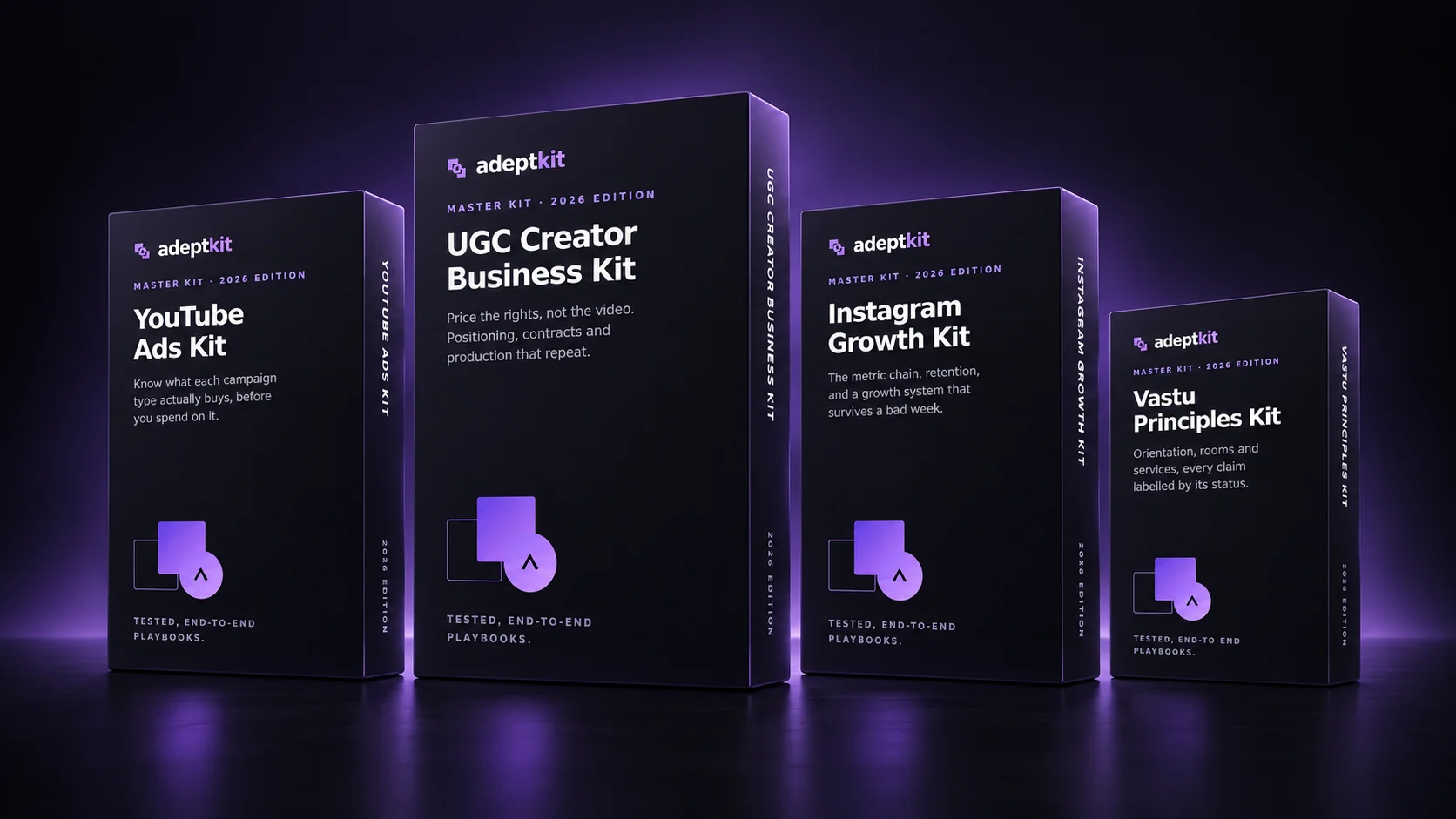
7 kits, each a complete system for one real problem. Every kit opens into its own page.

Positioning, rights, pricing and production for creators who sell assets rather than audience.

Campaign roles, creative that survives the skip, and measurement you can defend to a finance team.

Positioning, content, community and operations for accounts that need repeatable growth.

A structured reference for recording, reading and applying traditional directional rules.

Messaging, page hierarchy, service framing, trust sections and conversion structure for professional businesses that need a stronger digital front door.

Offer selection, funnel logic, traffic choices and conversion thinking for building a repeatable affiliate revenue system.

A working system for interior projects: brief, measured survey, space and lighting plans, room-by-room design, sourcing, budget and handover. Written for designers, architects and owners running their own project.
Nine of the ten kits share one structure, shown here. The tenth, the Claude prompt library, is 250 recipes in 11 categories.
Each module starts with a real decision question instead of a broad topic label.
Three short concepts explain what matters, with benchmarks, evidence labels or common mistakes called out.
A five-step playbook moves the reader from concept to operational action.
Failure modes, scoreable checks and a release gate stop false confidence.
Readers should be able to move from understanding to action without leaving the kit or guessing the next step.